

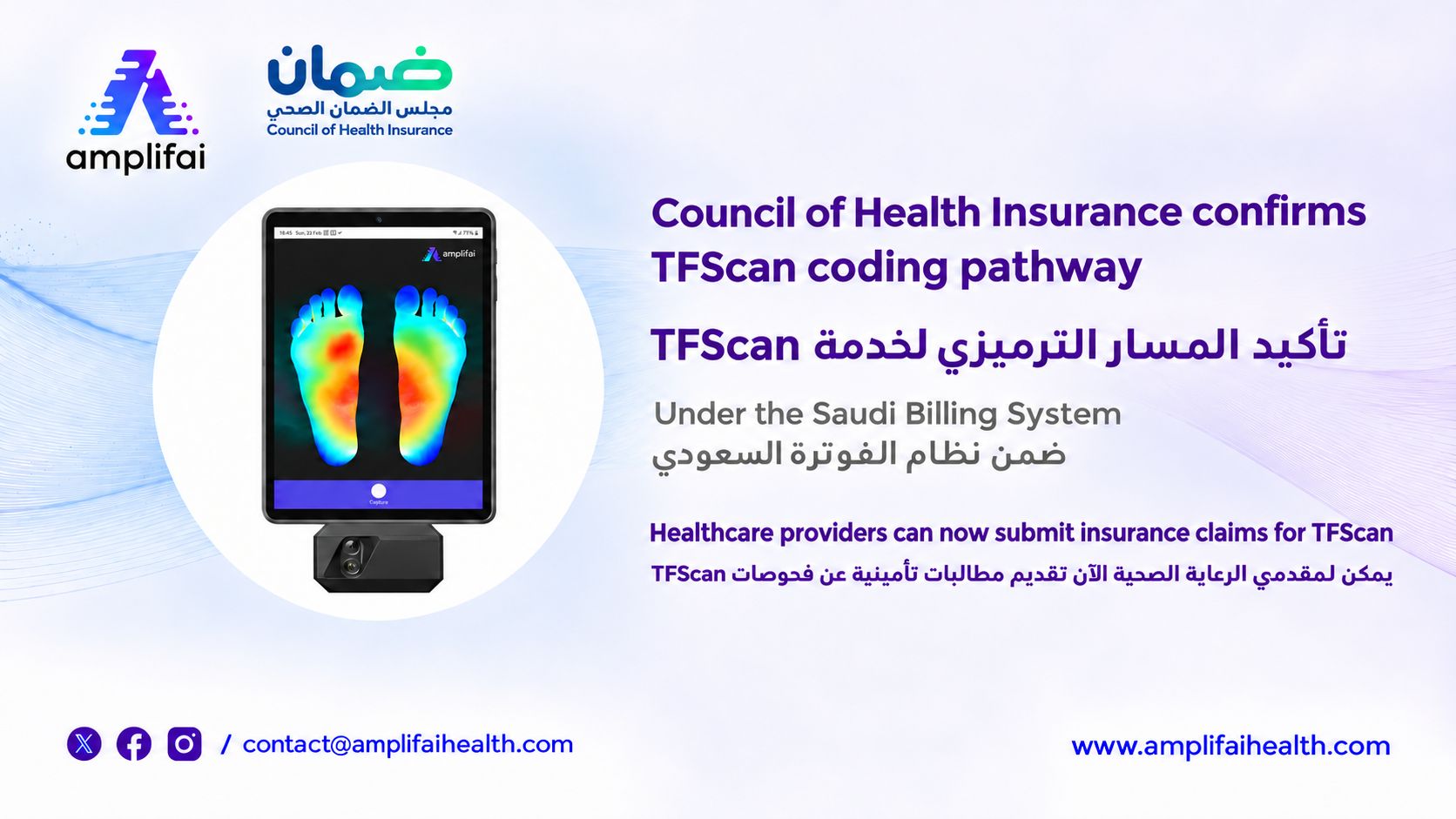
TFScan, the AI-assisted thermal imaging system for diabetic foot risk screening developed by Riyadh-based Amplifai Health, now has a route to insurance reimbursement in Saudi Arabia. The Kingdom’s Council of Health Insurance (CHI) has confirmed a coding pathway for the system under the Saudi Billing System, according to Amplifai Health’s chief executive.
Announcing the step on LinkedIn, Dr Meshari F. Alwashmi said healthcare providers can now submit insurance claims for diabetic foot screening carried out with TFScan. He described it as a practical move by the health insurance system to support AI in patient care during what Saudi Arabia has designated its Year of AI.
Table of Contents
What has changed
The Saudi Billing System (SBS) is the standardised set of procedure and service codes that CHI introduced to replace the in-house billing codes once used across the private health insurance sector. Providers and insurers use it to describe what was done for a patient, and claims are processed against it.
Until now, a clinic using TFScan had no clear way to bill an insurer for the scan. With a confirmed coding pathway, the screening can be submitted as a claim like other recognised services. Dr Alwashmi’s announcement does not give the code itself, the tariff, or which insurance policies will cover it, and IMEA POD has not yet seen a CHI circular on the decision. Providers should confirm the details with CHI and their contracted insurers before billing.
Why a billing code matters
Regulatory approval tells a clinic that a device can be used. Reimbursement decides whether it actually is. Many digital health tools that clear the first hurdle stall at the second, because providers cannot recover the cost of the extra time and equipment.
Dr Alwashmi framed the change in those terms. He said he wants more people screened during the diabetes visits they already attend, and that a way to submit claims helps make that possible. In a country with a high burden of diabetes and diabetes-related amputation, moving foot screening into routine visits, rather than relying on specialist referral, is the kind of shift that payers can encourage or block.
What TFScan does and what the evidence shows
TFScan uses a compact thermal camera connected to a smartphone or tablet to image both feet. Software analyses temperature patterns and asymmetries that can signal inflammation before the skin breaks down, and returns a risk score. The system received marketing authorisation from the Saudi Food and Drug Authority in early 2025, and IMEA POD reported earlier this month that it is now offered to clinics in the UAE through ARJ Group.
The main published evidence is a multicentre cross-sectional study in JMIR Formative Research involving 1,120 people with diabetes in Riyadh, Qassim, Madinah and Al-Baha. TFScan placed 9.3% of participants in its moderate or high-risk categories, and those groups carried a clearly higher burden of vascular disease, neuropathy and thermal abnormalities.
That shows the risk categories line up with known clinical risk factors. It does not yet show that the score predicts who will go on to ulcerate; the authors call for longitudinal studies. They also note that some data were self-reported, assessors were not blinded, and room temperature and skin moisture may have affected readings. Two of the authors, including Dr Alwashmi, are employees and shareholders of Amplifai Health.
What it means for foot health professionals
For Saudi diabetes clinics, primary care centres and hospital foot services, a claimable scan lowers the financial barrier to adding thermal screening. It may also act as a signal to other Gulf payers watching how AI tools are brought into routine care.
Thermal screening still works best as an addition to the diabetic foot examination recommended by the International Working Group on the Diabetic Foot (IWGDF), not a replacement: inspection, monofilament testing, pulse assessment and footwear review remain the foundation. And a risk score only helps if a flagged patient can be seen quickly by a podiatrist, diabetic foot clinic, vascular service or pedorthist.
Providers considering TFScan may want to ask:
- Which SBS code applies, and what tariff and documentation do insurers require?
- Which policies and insurers currently accept the claim?
- How does the score map to IWGDF risk categories and review intervals?
- What referral pathway is in place for patients flagged as high risk?
Amplifai Health says hospitals and clinics interested in TFScan can contact the company through Dr Alwashmi on LinkedIn or at contact@amplifaihealth.com. For more regional coverage, see IMEA POD’s Diabetic Foot section.
Suggested Hyperlinks
- Dr Meshari F. Alwashmi on LinkedIn (source announcement)
- Council of Health Insurance on LinkedIn
- Council of Health Insurance: Saudi Billing System
- Amplifai Health on LinkedIn
- AI-Powered Thermography for Diabetic Foot Risk Stratification: Multicenter Cross-Sectional Study (JMIR Formative Research, 2025)
- MedTech World: Amplifai Health’s AI diabetic foot scanner gets SFDA authorisation
- IMEA POD: TFScan AI thermal foot screening now available in UAE through ARJ Group
- IWGDF Guidelines on the prevention and management of diabetes-related foot disease
[…] Professor Gatt ends with a question for colleagues: do you give your patients a written summary of their foot assessment? For more regional coverage, see IMEA POD’s Diabetic Foot section, including our report on TFScan’s new Saudi insurance coding pathway. […]