

Diabetic foot screening too often ends the same way: “all fine, see you next year.” The findings stay in the clinician’s notes and the patient goes home with nothing. Professor Alfred Gatt of the University of Malta, a podiatrist with more than 40 years in the profession, argues that this is a missed opportunity, and that every patient should leave an annual foot review with a short written report.
Writing on LinkedIn, Professor Gatt said people with diabetes want to be part of their own foot care: to know what was found, what it means and what they can do about it. A report, he argues, is the simplest way to make the patient a partner.
Table of Contents
Five reasons for a written report
Professor Gatt sets out five ways a short written summary changes the screening visit:
- It explains risk. “Your sensation is reduced in both feet” carries more weight on paper than in a rushed conversation.
- It supports self-care. Daily foot checks and footwear advice make more sense when patients understand why they matter.
- It sets the next step. A clear review date and what to watch for between visits.
- It connects the team. Patients can show it to their GP, diabetes nurse or diabetologist, so everyone works from the same findings.
- It builds trust. Being shown the evidence is very different from being told “it’s fine”.
The argument fits the direction of international guidance. The International Working Group on the Diabetic Foot (IWGDF) places structured education of people with diabetes, and regular screening tied to a risk category and review interval, at the centre of ulcer prevention. A written summary turns that category and interval into something the patient can see and act on.
DiabFoot Pro: a report at every visit
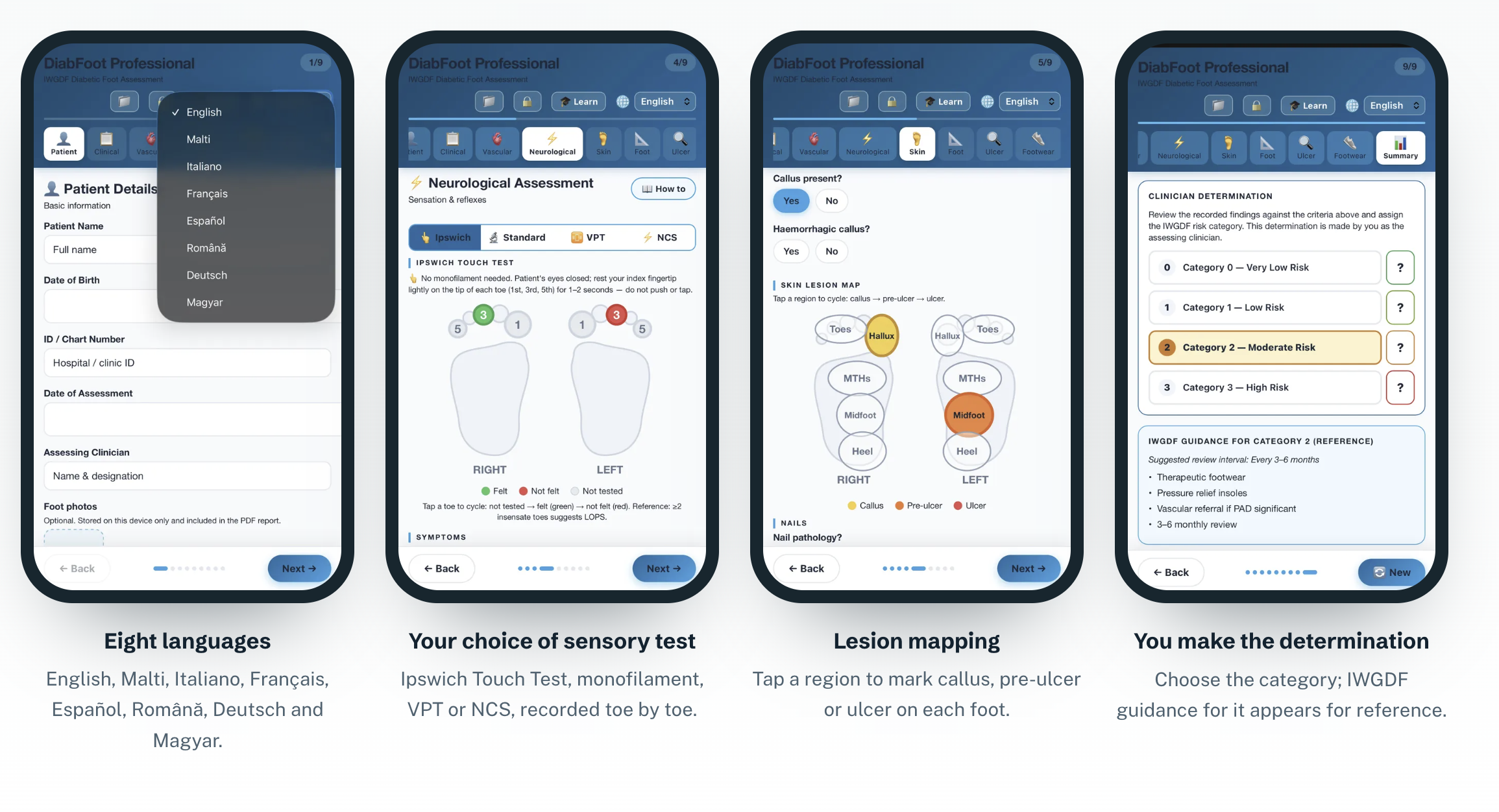
Professor Gatt has built that idea into DiabFoot Pro, a web-based tool that guides clinicians through a structured lower-limb assessment for people with diabetes, built around current IWGDF guidance. After the assessment it produces a dated PDF report with the findings, the risk category assigned, the clinician’s plan and any photos, ready to print or share with the patient. He says it takes seconds, so the report can happen at every visit rather than only when there is time.
- Nine guided screens: patient details, clinical history, vascular, neurological, skin, foot deformity, ulcer, footwear and summary.
- Choice of sensory test: Ipswich Touch Test, 10 g monofilament, vibration perception or nerve conduction results, recorded toe by toe.
- Vascular references: Doppler waveform references for each pedal artery, plus toe pressures and toe-brachial index.
- Lesion mapping: tap a region of each foot to mark callus, pre-ulcer or ulcer.
- Clinician-led risk: the summary shows IWGDF criteria next to the findings, but the clinician assigns the category; the app does not decide risk.
- Eight languages: English, Maltese, Italian, French, Spanish, Romanian, German and Hungarian, switchable mid-assessment.
The tool runs in a browser on phones, tablets and computers and can be added to a home screen without an app store download. A free version has no expiry; DiabFoot Pro, which adds PDF reports, saved patient records, recall reminders, photos and backup, costs €79 (about USD 92) a year, with VAT where it applies.
Why it matters across IMEA
In much of the Middle East, Africa and South Asia, diabetic foot care is shared between nurses, general physicians, diabetologists and a small number of podiatrists, often in different facilities. A patient-held report is a low-cost way to carry findings between them, especially where shared electronic records do not exist.
The French-language option will be useful in North and West Africa. Arabic, Urdu, Hindi and other major regional languages are not yet among the eight, which limits patient-facing use in much of the region for now.
Points to check before adopting a tool
DiabFoot Pro’s website describes it as a clinical documentation and reference tool for qualified professionals and supervised students, which does not replace clinical judgement, and it makes no medical device claims. Clinics considering it, or any similar tool, should check where patient data and photos are stored and how they are protected against local data protection rules, and how reports fit with their own medical records.
Professor Gatt ends with a question for colleagues: do you give your patients a written summary of their foot assessment? For more regional coverage, see IMEA POD’s Diabetic Foot section, including our report on TFScan’s new Saudi insurance coding pathway.
Suggested Hyperlinks
- Professor Alfred Gatt on LinkedIn (source post)
- DiabFoot Pro
- IWGDF Guidelines on the prevention and management of diabetes-related foot disease
- IMEA POD: Diabetic Foot