

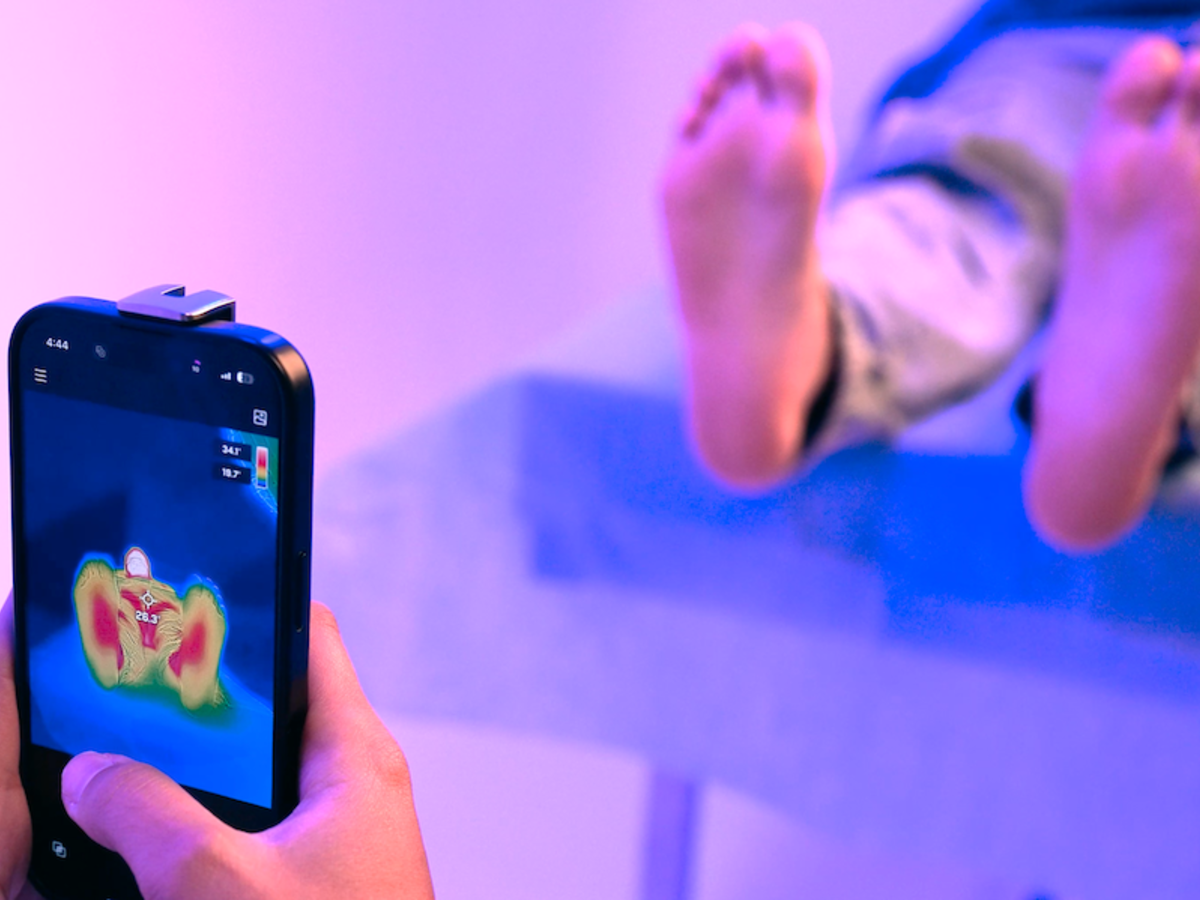
TFScan, an AI-assisted thermal imaging system for diabetic foot risk screening developed in Saudi Arabia, is now being offered to clinics in the United Arab Emirates. Distributor ARJ Group announced on LinkedIn that the system, made by Riyadh-based Amplifai Health, is available in the UAE through the company.
The pitch is aimed squarely at the front line of diabetes care. ARJ Group argues that foot screening should not depend on a specialist referral, and positions TFScan for primary care and diabetes clinics, where most people with diabetes are already seen.
What TFScan does
According to ARJ Group, TFScan uses a portable thermal camera to image both feet in a matter of seconds. Software then analyses the images for temperature changes that may point to a developing problem and produces a risk score. The distributor describes that score as explainable and aligned with the guidelines of the International Working Group on the Diabetic Foot (IWGDF).
- Capture: a portable thermal camera images both feet at the point of care.
- Analysis: AI flags temperature patterns associated with elevated risk and returns a risk score.
- Follow-up: results are tracked over time so that trends between visits can be reviewed.
- Integration: the system is said to connect with existing electronic medical record and HL7 infrastructure.
In a submission to MIT Solve, Amplifai Health describes the hardware as a compact thermal camera connected to a smartphone or tablet, and says the system needs minimal training to operate.
Why foot temperature matters
Inflammation in the foot tends to show up as a local rise in skin temperature before the skin breaks down. In a person with neuropathy, who may feel nothing, that warm spot can be the only early sign. This is the reasoning behind foot temperature monitoring, which the IWGDF prevention guidance includes as an option for people at moderate or high risk of ulceration.
Clinic-based thermography extends the same idea to a whole-foot image taken during a routine visit. For much of the IMEA region, where podiatrists are few and foot checks fall largely to nurses and general physicians, a quick, objective screening step has clear appeal.
What the evidence shows so far
The main published evidence is a multicentre cross-sectional study in JMIR Formative Research, published in November 2025. It involved 1,120 people with diabetes attending clinics in four Saudi regions: Riyadh, Madinah, Qassim and Al-Baha.
- TFScan classified 9.3% of participants (104 people) as moderate or high risk, and 90.7% as low or very low risk.
- Peripheral artery disease was reported in 20.2% of the higher-risk group against 0.8% of the lower-risk group. Neuropathy, foot deformity and cardiovascular disease were also more common.
- A temperature difference of 2.2 °C or more between feet was found in 7.1% of participants, mostly in the moderate and high-risk groups.
These findings show that the system’s risk categories line up with known clinical risk factors. They do not yet show that it predicts who will go on to ulcerate. The authors acknowledge that a cross-sectional design cannot establish this and call for longitudinal validation. They also note that some clinical data were self-reported, that assessment was not independently blinded, and that room temperature and skin moisture may have affected readings.
Readers should also note the declared interests: two of the authors are employees and shareholders of Amplifai Health, and the study had commercial sponsorship.
Regulatory status
In Saudi Arabia, TFScan received medical device marketing authorisation from the Saudi Food and Drug Authority, as reported by MedTech World in February 2025. ARJ Group’s announcement does not state the product’s regulatory registration status in the UAE. Clinics considering the system should ask the distributor for this directly.
What it means for foot health professionals
Thermal screening is best understood as an addition to the diabetic foot examination, not a substitute for it. Inspection, monofilament testing, pulse assessment and footwear review remain the foundation of risk stratification under IWGDF guidance.
The practical value of any risk score also depends on what happens next. A patient flagged as high risk in primary care needs somewhere to go: a podiatrist, a diabetic foot clinic, a vascular service or a pedorthist for offloading footwear. Without a referral pathway, earlier detection does not become earlier treatment.
Clinics evaluating TFScan may want to ask:
- What prospective data exist linking a high-risk score to later ulceration?
- What is the UAE regulatory registration status?
- How should room conditions and patient preparation be standardised before imaging?
- How does the score map to IWGDF risk categories and review intervals?
- What does integration with the clinic’s medical record system involve in practice?
For more regional coverage, see IMEA POD’s Diabetic Foot section, including a South African case showing the cost of delayed foot ulcer care and why timely vascular referral matters for limb salvage.
Suggested Hyperlinks
- ARJ Group on LinkedIn (source announcement)
- Amplifai Health on LinkedIn
- AI-Powered Thermography for Diabetic Foot Risk Stratification: Multicenter Cross-Sectional Study (JMIR Formative Research, 2025)
- MedTech World: Amplifai Health’s AI diabetic foot scanner gets SFDA authorisation
- MIT Solve: Thermal Foot Scanner (TFScan) submission
- IWGDF Guidelines on the prevention and management of diabetes-related foot disease