

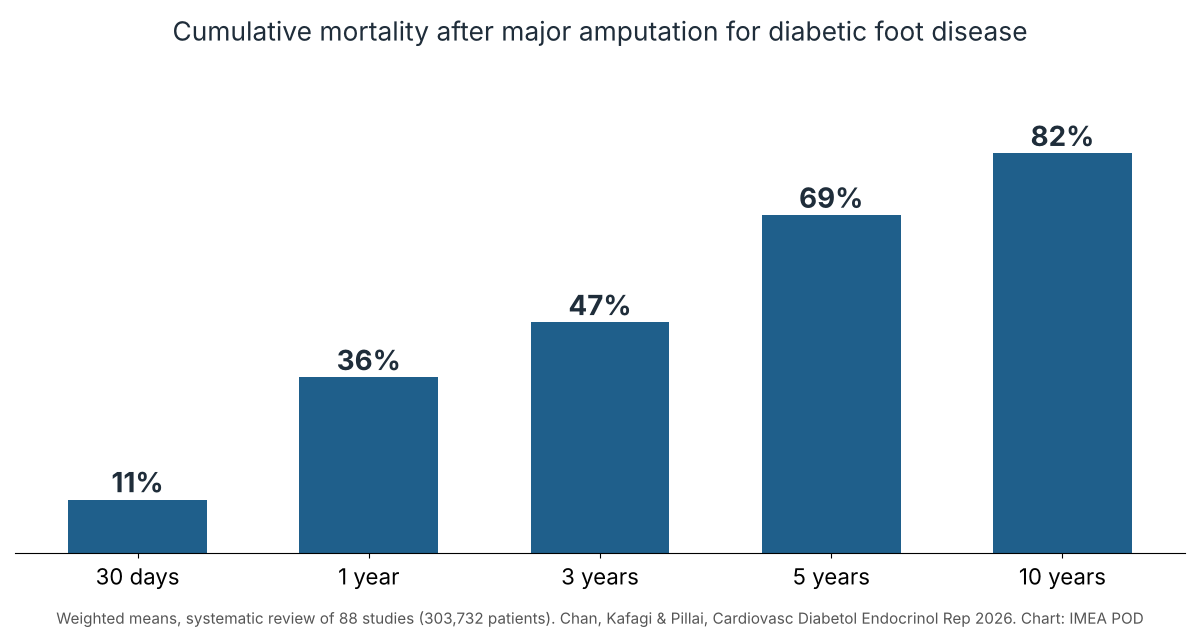
Mortality after major amputation for diabetic foot disease is higher than earlier reviews suggested, according to a systematic review of 88 studies and 303,732 patients published on 16 November 2026 in Cardiovascular Diabetology – Endocrinology Reports. On average, 36% of patients had died within a year of a major amputation, 69% within five years and 82% within ten.
What the review found
The review, by Alisha Chan, Abdul-Hadi Kafagi and Anand Pillai, with authors from the Department of Trauma and Orthopaedics at Wythenshawe Hospital, Manchester University Hospitals NHS Foundation Trust, UK, searched PubMed, EMBASE and MEDLINE up to May 2026. It was registered on PROSPERO and followed PRISMA guidance. Most of the included studies were retrospective cohorts, and the mean patient age was about 65 years.
For major amputations, analysed across 53 cohorts and 71,878 patients, the weighted mean mortality was:
- 11.0% at 30 days
- 36.1% at one year
- 47.3% at three years
- 69.4% at five years
- 82.0% at ten years
In-hospital mortality was 10.0% after major amputation, compared with 6.0% across all amputations, major and minor combined. Five-year mortality for the whole amputation group was 55.3%. Among major amputations, 7.2% of patients needed a further amputation within six months and 18.3% within a year. The authors note that five-year mortality after major amputation is higher than in reviews published in 2020, and say amputation “marks the start of a period of extremely high mortality risk”.
Limits of the evidence
Follow-up periods and outcome time points varied so much between studies that a formal meta-analysis was not possible, so the figures are weighted means rather than pooled estimates. Data beyond one year are sparse, confidence in the ten-year figure is limited, and only English-language studies were included. The review does not report results by region, so it cannot show whether outcomes differ in the Middle East, Africa or South Asia. The authors call for standardised reporting and longer-term studies.
IMEA POD Perspective
A five-year mortality of almost 70% is worse than that of many common cancers, and it should change how foot teams, hospital managers and ministries talk about major amputation. It is not a cure for a bad foot; for most patients it is the beginning of the end. Across the IMEA region, where diabetes accounts for nearly half of amputations in Oman and patients often present late, these figures make the economic and human case for prevention, early referral and limb salvage. The Abuja team that cut amputations from 50% to 10% and the push for timely vascular referral in Bengaluru show what organised teams can achieve. The review also exposes a gap: almost none of this evidence comes from our region. Gulf, African and Indian centres should start recording long-term survival after amputation, with standard time points, so that local data can drive local funding decisions.
Sources and further reading
- Chan A, Kafagi A-H, Pillai A. Mortality and re-amputation rate of major amputations in diabetic foot disease: a systematic review of 303,732 patients. Cardiovascular Diabetology – Endocrinology Reports 2026;12:67 (published 16 November 2026)
- Bioengineer.org: Major amputations for diabetic foot disease linked to high long-term mortality (16 November 2026)
- IMEA POD: Oman: Diabetes behind 47% of amputations, foot review finds
- IMEA POD: Abuja foot team cuts diabetic amputation rate from 50% to 10%
- IMEA POD: Gulf Diabetic Foot Working Group publishes first Gulf-specific DFU guidelines